
The Wand (STA) Anesthesia
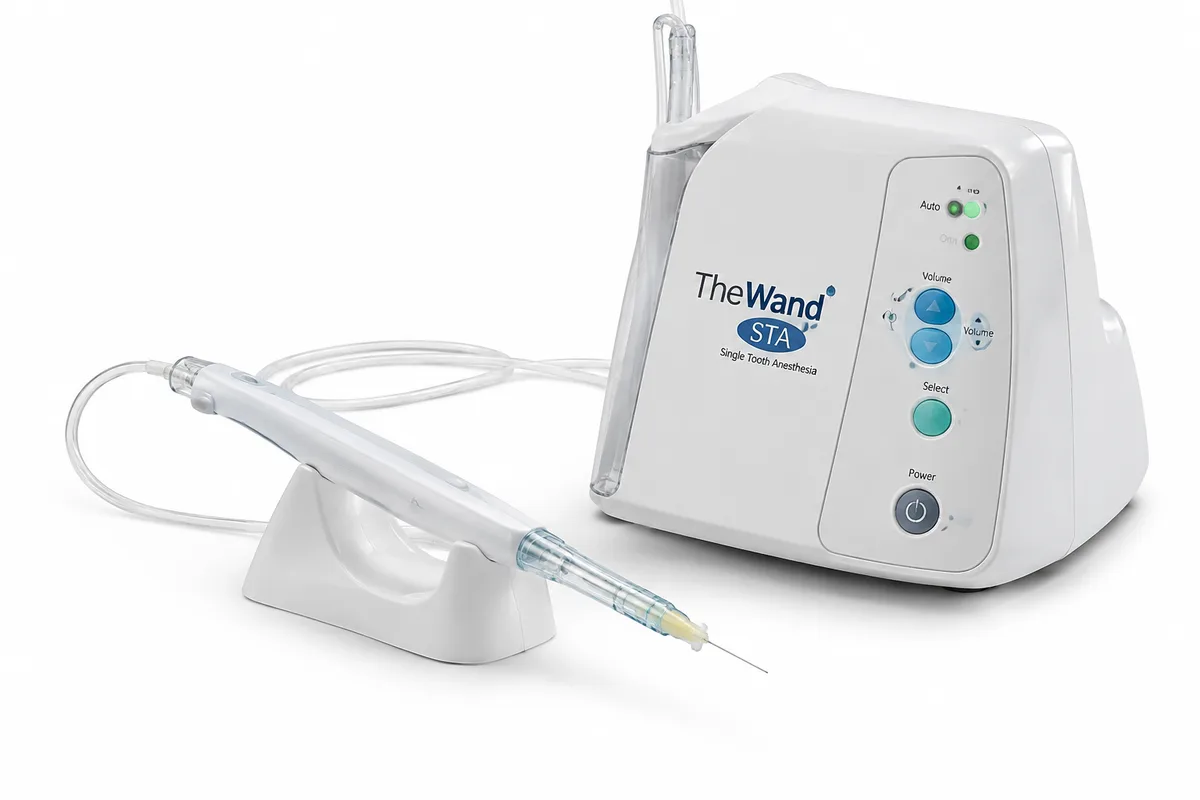
The Wand (STA) Anesthesia
The Wand, also known as STA (Single Tooth Anesthesia), is a computer-controlled system for delivering local anesthesia. Instead of a hand-controlled syringe, a computer regulates the flow and pressure of the numbing solution, allowing it to be delivered slowly and evenly. At Dental Office of Dr. Salm, Kanner, and Grandeau, it is one of the ways we work to make routine numbing feel calmer and more predictable.
What the Wand (STA) Anesthesia is
Traditional dental anesthesia relies on a dentist manually pressing a syringe plunger, which can send solution into the tissue in an uneven rush. That sudden pressure is often what patients describe as the uncomfortable part of getting numb — not necessarily the needle itself. The Wand addresses this by using a computer to control the rate of delivery from start to finish, keeping the flow slow and consistent throughout the injection.
Because the device also controls pressure, it can be used for very precise, single-tooth injections in addition to broader numbing. This gives a dentist more control over exactly which area goes numb, rather than numbing a larger region than necessary. The instrument itself still uses a needle, but it's guided by a lightweight, pen-like handpiece rather than a traditional syringe, which changes how the whole experience looks and feels to the patient in the chair.
How we use it at Dental Office of Dr. Salm, Kanner, and Grandeau
Our dentists — Dr. Adam Salm, Dr. Jed Kanner, and Dr. Hayley Grandeau — are general dentists who administer local anesthesia as a routine part of everyday dental care, and the Wand is available as part of that process. Its computer-controlled, slow delivery is used to make the numbing step of common procedures, such as fillings, crowns, or root canal therapy, feel more comfortable than a standard syringe.
The Wand often works alongside other equipment in our office. For patients who are anxious about needles or dental visits generally, it can be paired with nitrous sedation to further ease the experience. During procedures that call for precision, such as rotary endodontics guided by an apex locator, precise single-tooth numbing helps the dentist focus treatment exactly where it's needed.
What it means for you
For patients, the main appeal of computer-controlled anesthesia is comfort. A slow, steady flow of anesthetic is generally associated with less of the pressure and stinging sensation that can come with a fast manual injection. This can make the moments before treatment feel less stressful, particularly for anyone who has had an uncomfortable numbing experience in the past.
Precision is another benefit. Because the Wand can target a single tooth, it may allow a smaller area to go numb rather than an entire side of the mouth or lip, which many patients find preferable — especially when only one tooth needs treatment. Clearer, gentler numbing can also make it easier to communicate with your dentist during the visit, since you're less distracted by discomfort at the start of the appointment.
What to expect during your visit
Before your treatment begins, your dentist will explain the procedure you're having and let you know that the Wand will be used to numb the area. A topical numbing gel may be applied first, as is standard for most local anesthesia. The handpiece is then guided to the injection site, and the computer controls the rate at which the anesthetic is released.
During the injection, you may notice that it feels different from a typical syringe — more gradual, with steady, even pressure rather than a quick push. The injection itself generally takes no longer than a standard one. Afterward, you'll experience the same numbness you would with any local anesthetic, and your dentist will proceed with your planned treatment once the area is ready.
Frequently asked questions
Is the Wand safe?
Yes. It delivers the same local anesthetics used in traditional dental injections; the difference is in how the medication is dispensed, not what is used. The computer-controlled delivery is simply a more regulated way of administering a standard, well-established type of anesthesia.
Will I still feel a needle?
You will still feel the initial insertion of the needle, though a topical numbing gel is typically applied first to minimize this. What most patients notice is a difference during the injection itself, since the slow, steady flow tends to reduce the pressure sensation associated with traditional syringes.
How long does numbing take with the Wand?
The injection itself takes about the same amount of time as a conventional one, and the numbing sets in on a similar timeline. The main difference is in how the anesthetic is delivered during that time, not the overall length of the appointment.
Who is the Wand suitable for?
The Wand can generally be used any time local anesthesia is needed, including for fillings, crowns, and root canal therapy. It can be especially helpful for patients who feel anxious about needles or who want more precise, single-tooth numbing rather than a broader numb area.
If you'd like to learn more about the Wand (STA) Anesthesia or ask whether it's a good option for your upcoming treatment, reach out to Dental Office of Dr. Salm, Kanner, and Grandeau — we're happy to talk through what to expect.